
The Dream

I have dreamt of writing this for a very, very long time, and so I hope you will indulge me for a moment.
Just past the old Hardinge Bridge, which connects the districts of Pabna and Kushtia together, there is a village called Sholodag. My family took me here almost every year, perhaps multiple times in a year, because that is where we were from. On the way to Sholodag, we would often stop by the Pabna graveyard, where many of our family are buried.
I resented these trips as a child. They took place during long, unbearable monsoon months. The air was hot and sticky, and it rained incessantly. But in all this discomfort, I still found some peace being with my grandfather, my Sunule. In the evenings, when the heat had subsided, my brother and I would rest our heads on his chest, and he would tell us both stories. One of those monsoon nights, after he told us about one of his adventures in cadet college, my Sunule made us promise him something. He made us promise him that we would go to an Ivy League school.
I had no clue what an Ivy League was -- I was only 8 at the time -- but I accepted this right away. It was in Sholodag that I had set my direction for life for the next decade. I told everyone around me I was going to go to an Ivy League the moment I was done with high school. You can tell, I was a very insufferable kid.
But you see, education is personal to our family. Far, far away from Kushtia, my roots are also in the village of Fadrakhala, in the district of Habiganj. My dadabhai grew up here. He grew up poor. He walked miles to go to school. He had to stay in the homes of relatives who did not want him there, who made him sleep on the floor, but he persisted. He became a radiologist.
Both my grandfathers had seen the things education can do for you. They were insistent that their children, and their children's children, take advantage of it. I was the first of my generation to start college, and I remember feeling the weight of expectation on me.
I remember sitting across from Abbu once, while I was going over my college list. We had bickered a lot over the list, but that day the room was silent. It must have been raining outside. His eyes were on the floor as he recounted to himself: he had also applied to the US when he was young. He had gotten into Vassar College and was all ready to go until the last minute: Dadabhai had forbidden it and could not afford to send him away that far. Now it was his turn to send his own son abroad, to places he never had the chance to go to all those years back. So, you see, it was as personal to him as it was to me. To fulfill dreams of a life he had long foregone but had worked endlessly to provide for his own children.
I also remember fighting with everyone over dinner at Ammu's once. We were discussing college choices, yet again. My Sunule was insistent on the Ivy League, while my mother flirted with the idea of going to Canada in pursuit of permanent residency. Everyone had an opinion. I could hear a million different voices in my head, and I could feel them ripping my heart into shreds. I had my first -- and only -- panic attack there. I ran right out and shut the door behind them. That was also the last time I ever fought with my Sunule.
The first school I applied to was Yale. I had dreamt of going there. I loved everything about the place. The family was convinced I would make it, but I was less sure. Sure enough, by December they had deferred me, and we were kept waiting on what would be next. By now, I had already left home for my last year of high school, over 2,000 kilometers away. I applied for the rest of the colleges there, all by myself. On the eve of the new year, I had applied to the dual program between Columbia and SciencesPo, almost entirely on a whim.
The new year brought with it a fierce COVID-19 wave. It had overwhelmed the entirety of the subcontinent. We were locked into our school. At home, my Sunule was infected with COVID-19 early in January. We spoke on the phone often. I told him about colleges as they came -- some of those safety ones that he never cared for -- he was still waiting to hear about whether the Ivy League colleges I applied to had responded yet.
I was near the end of my path: after fourteen years of work, after insisting for all those years I would go to an Ivy League, it would boil down to the decisions of two schools: Columbia and Yale. The family watched on keenly. I last spoke to my Sunule on the 14th of February, on Valentine's Day, just before I headed out with my girlfriend at the time. I wore the yellow panjabi my Nina had given me. He told me I looked very handsome, and I went on.
I got the email from Columbia the next day: they wanted to interview me. An interview more or less means you get in: almost everybody makes it after that stage.
I refused to tell anybody this news. I did not tell my mom, nor did I tell my dad. Above all, I did not tell my Sunule, because I wanted to go home, and to hand him the acceptance letter from Columbia myself.
My Sunule died two days later. On the 17th of February, in the evening. Ma had called me that afternoon so I could speak to him, but I was in Math class. I told her I would call her later -- she told me it's fine, that she was just taking him to the hospital and they would be back.
By the time I was home, he was gone. I told you then, and I will tell you again, my heart broke into a million pieces that day. I had collapsed on the ground, and I remember crying uncontrollably. I held onto the shawl my Sunule gave me before I had gone to India. It was all that I had left of him.
My dad drove from Mumbai to Pune to see me the next day. For three days all I could do was cry. I ate nothing, I barely slept, all I did was cry. I was not there when they laid him into the ground. I did not even watch it. I could not take it. For the years that followed, I tried to write many stories from the events of his burial. To try and sketch an image of it in my mind, because I was not there. Each time, I failed.
Four years have passed by. I still cannot forgive myself for not being there for his burial. I still cannot forgive myself for not picking up that call, so I could hear him for the last time. But above all, I still cannot -- and will never -- forgive myself for never telling him that I did it, that I got into an Ivy League. That I could never tell him that I did it for him.
I wore my Sunule's shawl when I graduated from high school. That morning, when I had taken it out of the drawer -- the first time since his passing -- I burst into tears. I did not stop crying even as I waited for my name to be called. I returned to Dhaka in May, to a house that was still in mourning. And I left by September, to start college, to finish this dream that weighed on the whole family.
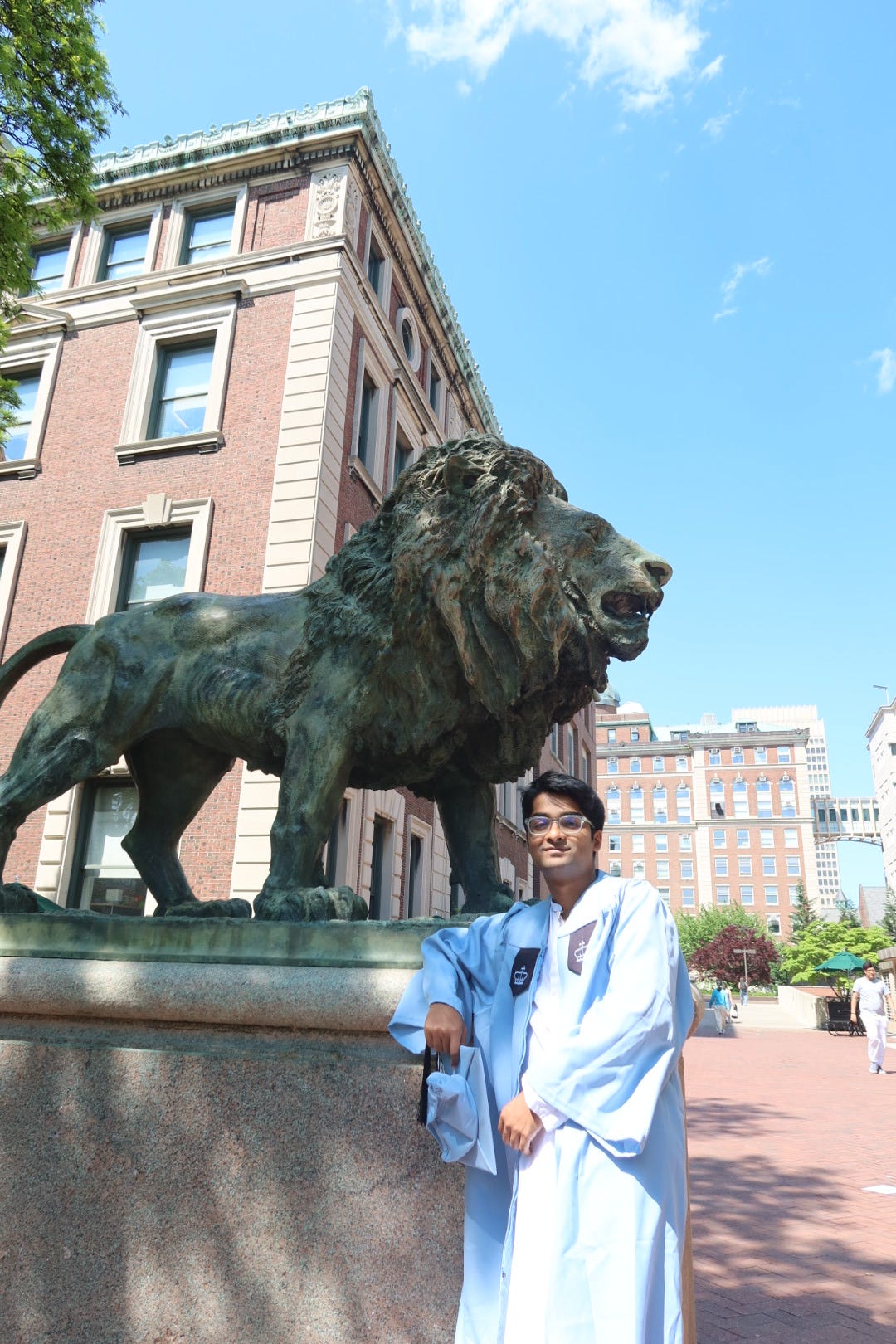
Four years later, I have graduated once again. Only this time from college: finishing up two degrees from two countries. I have lived a life that I could not even dream up, and I am profoundly grateful for it. I walked the stage two days ago, before the towering Low Library of Columbia. This time, my family was there for it: Ammu, Abbu, Aubon, and my Tom Mama. They watched as they announced my name, and as I crossed the stage. Wrapped around my shoulders was my Sunule's shawl.
The shawl felt lighter that day, as though a heavy weight had been lifted from my heart. Abbu and Ammu were in tears when they hugged me. This was the culmination of a dream that we held in our beating hearts, from one generation to another.
My dadabhai slept on the floors of unkind family so he could go to school. But he became a radiologist, and he sent his kids to the best schools of the country. My dad never got to go abroad, but he spent his life working his way up a company he has given his life to. And now, I have graduated college. A Dual BA between Columbia University and SciencesPo. But would you believe me if I told you that this journey began in a ramshackle homestead in Fadrakhala, over in Habiganj?
My Sunule was the son of a Sufi pir, an ascetic man with little to his name. He went to Cornell for his PhD and came back to work for his country. He was not particularly good at encouraging my mom to do well in school, but she too has worked her way up to become a towering executive. I have graduated college in her name too, because she has since succeeded her own fathers, and inhers his dreams into hers. Would you believe me if I told you that this journey began under the watchful eye of a Sufi in Bheramara, over in Kushtia?
I am the product of generations of work, of generations of dreams. And so, this education has been nothing short of a privilege that has been afforded to me. Nothing is truly over: education is only a part of the dream. What is left is to be good to people, to be good to the world, and to be of service to it. To be of service to my country. That is what I must do now for the rest of my life. When it is my time to go, I want to be able to look at my mother and father, my grandmothers and grandfathers, and tell them that I did justice to their sacrifices and their lives.
Right now, for this moment, I am reveling in my graduation. I am treating myself to a Viennese coffee at the Hungarian cafe, a few minutes' walk from Columbia. But in my heart of hearts, I am thinking about the Pabna graveyard I hated visiting as a kid.
My Sunule is buried there now. Right next to his mother, near the entrance. When I go back this time, I can finally tell him: my Sunule, I have done it, I have graduated from an Ivy League, I have fulfilled that innocent promise I made to you all those years ago, and I did it for you.
I did it all for you.
.